E-cigarette price: what the label never tells you
The figure on a shelf edge tells you almost nothing about what a device will cost you. The e-cigarette price that matters is decided elsewhere: in the pod, in the coil, in the bottle, and above all in how often each of those has to be replaced. Two kits sold for the same amount can drift a long way apart over twelve months, and the gap is visible before you buy if you know which line to read.
E-cigarette price: what the bill actually covers
Every vaping budget splits into two blocks that behave nothing alike. There is a one-off purchase, the kit, and there is a recurring spend, the consumables.
The kit is paid for once and then forgotten. Pods or coils, e-liquid and, on some hardware, cells are bought again every few weeks, and they are the block that decides the year.
Across British retail, the recurring block overtakes the one-off block within the first few months for most people. Anyone reasoning purely from the sticker on the kit is therefore comparing the smaller half of the problem.
The useful habit is to convert an e-cigarette price into a cost per month. That single move makes two devices comparable, which a purchase figure never does.
What the hardware tier buys you
British shops broadly sell three tiers, and moving between them changes capability rather than quality of manufacture.
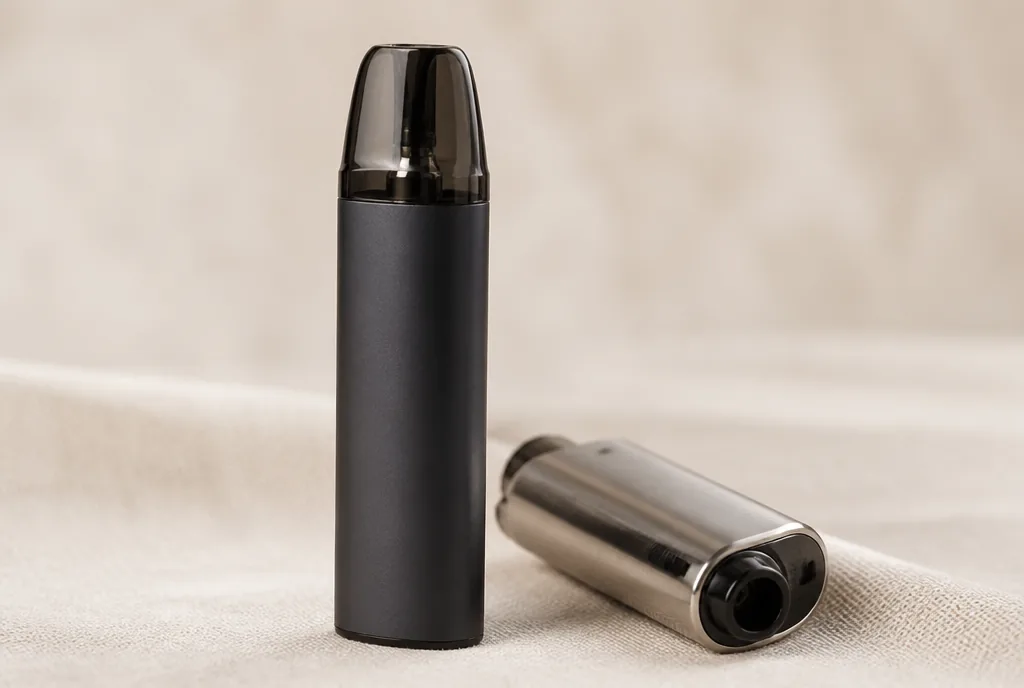
The entry tier is the simple refillable pod: a modest fixed battery, inhale activation, no settings, and a 2 ml pod. It is the largest part of the market by volume and the tier most first devices belong to.
The middle tier adds a larger cell, adjustable airflow and often adjustable power with a small screen. Runtime is the real purchase here, not performance.
Above that sit box mods running a removable cell with a 510 fitting. The cost structure changes shape at this point, because the cell becomes its own line with its own life measured in charge cycles.
The step between tiers is smaller in cash terms than the step in running costs between two devices in the same tier. That is the counterintuitive part, and it is why tier alone is a poor guide.
Consumables, the line that actually recurs
Only one block comes back every month, and it has two components whose weight depends entirely on the hardware you chose.
E-liquid comes first. Nicotine-containing liquid is sold in Britain in bottles of no more than 10 ml at a maximum strength of 20 mg/ml, so larger formats on the shelf are always nicotine free and intended to be finished at home with shots.
The comparable figure is never the bottle, it is the cost per millilitre. Large formats land lower per millilitre than small ones, and the gap that looks trivial on one bottle stops looking trivial across a hundred millilitres.
The second component is the wear part, and it is the one most comparisons quietly skip. On a device with replaceable coils, only the coil is thrown away. On a device with a sealed cartridge, the whole reservoir goes in the bin with its coil inside.
That difference is structural. A sealed cartridge is several times the cost of a bare coil for the same service, and it is the single largest fork in the road for the e-cigarette price over a year.
The variables that move the e-cigarette price
Five factors explain most of the spread between two people running similar hardware. None of them appears on the box.
The first is the fitting. Many pods use a proprietary cartridge that exists only from the manufacturer, which means one supplier sets the recurring cost for the entire life of the kit. This is the most structural variable of all and almost never raised in a shop.
The second is tank capacity. British rules cap a refillable tank at 2 ml, so the variable is not volume but how often the fill port is worked, and fill ports are a common failure point.
The third is coil resistance. A lower resistance runs hotter, vaporises more liquid per puff and wears faster, which raises both halves of the recurring block at once.
The fourth is frequency of use, obvious but rarely written down. The fifth is where you buy, since the same reference moves noticeably between British retailers and delivery thresholds change the maths on small baskets.
Turning the e-cigarette price into a monthly figure
The calculation is three lines long and can be redone in two minutes whenever habits change. It produces a number that is comparable across any two devices.
Line one is monthly liquid volume in millilitres multiplied by your real cost per millilitre, taken from the references you actually buy rather than from a catalogue average.
Line two is the number of pods or coils worn out in the month multiplied by the unit cost of that wear part. This is the line that separates devices that looked identical at purchase.
Line three is the kit divided by its expected life in months. Over two years of use this line becomes almost invisible, which is the clearest proof that the purchase figure is not the subject.
Our breakdown of what a vape pod costs by tier applies the same three lines to the pod segment specifically.
Why British price ranges are about to move
Any range quoted today has a short shelf life, and in Britain there is a dated reason for that on top of the usual ones.
A Vaping Products Duty applies from 1 October 2026, charged per millilitre of e-liquid and levied regardless of nicotine content, with VAT applied on top of the duty. A duty stamps scheme runs alongside it, and from 1 April 2027 vaping products on the market are expected to carry a stamp.
The practical consequence is that the liquid line of every budget rises, while the hardware line does not. Any comparison built before that date understates the recurring block and overstates the importance of the kit.
Two ordinary mechanisms sit on top of that. Generation turnover pulls the previous model down as soon as a successor lands, and promotional cycles move entry kits sharply for a few days at a time.
There is also a supply-side change worth remembering. Single-use vapes have been banned from sale across the UK since June 2025, which pushed the entry point of the market towards refillable pods and made the consumables question unavoidable for buyers who previously had none.
The conclusion is not to memorise ranges but to track two numbers of your own. Our method for tracking refill costs sets out how to keep them current, and the rest of our prices coverage applies the same reading elsewhere.
Frequently asked questions
What does an e-cigarette cost in its first year?
The first year carries the kit and twelve months of consumables at once, so it is always the heaviest. From the second year only the recurring block remains, unless the hardware is replaced.
Does a dearer kit always cost less to run?
No, but it often does. A well-equipped kit using standard coils can undercut a cheap kit locked to proprietary cartridges within months. The question to ask in a shop is the cost of the wear part, not of the kit.
Why are nicotine bottles limited to 10 ml in Britain?
British law caps nicotine-containing e-liquid at 10 ml per bottle and 20 mg/ml in strength. Larger bottles on sale are nicotine free by design and sold to be finished with separate shots.
Is buying online cheaper than buying in a shop?
Online references are generally lower, but delivery charges change the arithmetic on small baskets and most retailers waive them above a threshold. The comparison only holds once delivery is included.
How do I estimate my liquid use before buying?
Not accurately, and no calculator fixes that. The workable method is to count fills over seven days once you have the device, then multiply by tank capacity to get a weekly volume.
Reading an e-cigarette price without guessing
A single number is meaningless on this market, because no two people run the same hardware the same way. The e-cigarette price worth knowing is the one your own arithmetic produces: your cost per millilitre, your cost per wear part, and the expected life of your kit. Those three values take minutes to work out, survive catalogue changes and absorb the October 2026 duty without being rewritten. Checking them before buying, rather than after, is the only reliable way to compare two devices on something other than a label.
Editorial content for adult readers only. Vaping products contain nicotine, which is a highly addictive substance. Not for sale to under-18s in the United Kingdom. This article is not a buying recommendation.